
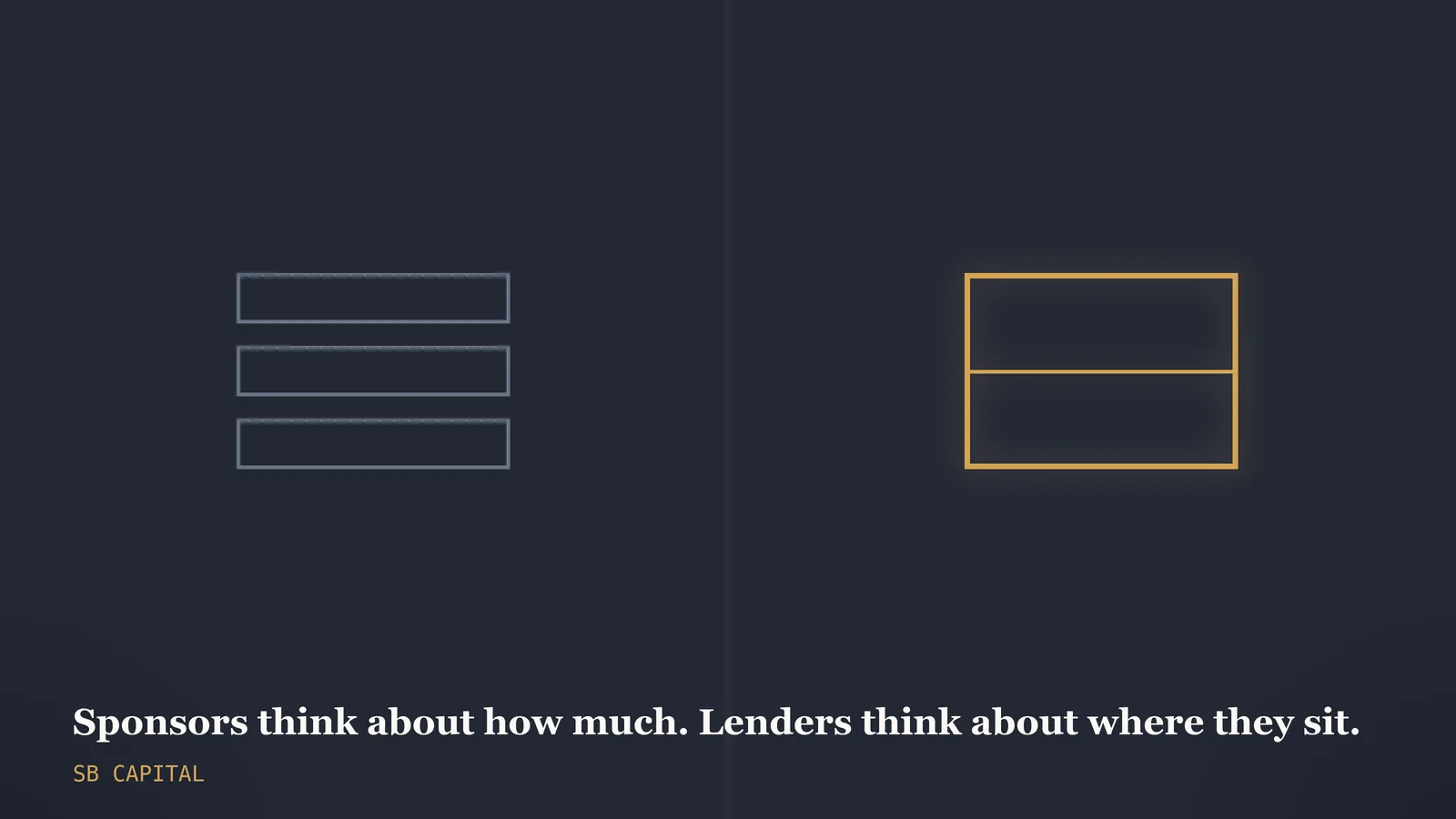
The capital stack is the order in which the money in a deal gets repaid. Senior debt sits at the bottom and is repaid first. Mezzanine debt sits above it. Preferred equity sits above that. Common equity sits at the top and is repaid last — which also makes it the first money to absorb a loss. Jerry R. Millington, who runs SB Capital for Studio Bananas Group and is Managing Partner of Brookmont Capital Ventures, introduces sponsors into that stack; this article describes it as it stands in August 2026, ahead of Brookmont’s direct-lending launch on 1 September 2026.
The stack is not an academic diagram. It is the reason a deal that pencils on paper does not close. Sponsors tend to think about how much capital they need. Lenders think about where they sit if something goes wrong. Those are different questions, and only one of them decides whether a deal gets funded.
Senior debt: the bottom of the stack
Senior debt is the first-position loan, secured by a first lien on the property. It is the largest layer in most deals and the cheapest, for the obvious reason: it is repaid first and it holds the collateral.
For transitional assets — a property being acquired, repositioned, leased up or refinanced before it qualifies for permanent financing — this layer is usually a bridge loan. Brookmont Capital Ventures, the capital partner we introduce sponsors to, lends directly in this layer. Its published direct credit box is a senior first-lien bridge of $250,000 to $5,000,000 on transitional residential and mixed-use property, for acquisition, refinance, value-add or lease-up.
Above and outside that box, larger and more complex requests are placed with third-party capital, across a broader range of roughly $200,000 to $15,000,000 and up. Placement and direct lending are two different things and the difference matters to a sponsor: a direct lender is making its own decision on its own paper and its own timeline. A placement is a match to somebody else’s credit committee.
Brookmont’s move into direct lending explains why that distinction changes a deal’s timing.
Mezzanine and preferred equity: the middle of the stack
Between senior debt and common equity sits the layer that most first-time sponsors discover late and under time pressure.
Mezzanine debt is subordinate debt. It ranks behind the senior loan for repayment and it is typically secured not by the property itself but by a pledge of the ownership interests in the entity that owns the property. We place mezzanine through Brookmont’s network.
Preferred equity is not debt at all. It is an equity position with a priority return and a defined position ahead of common equity, and it is structured inside the ownership entity rather than as a loan against the asset.
The two get used interchangeably in conversation and they are not interchangeable in a document. What they have in common is their function: they fill the gap between what the senior lender will advance and what the sponsor can or wants to contribute.
Common equity: last in line, first to lose
Common equity is the sponsor’s own capital plus that of any limited partners. It is repaid after every other layer has been satisfied, which is why it carries the highest expected return and the entire downside.
There is a plain consequence worth stating: every dollar of debt you add increases the return on your own equity when the deal performs and accelerates the loss when it does not. Leverage is not free money. It is a trade of cushion for return, and the size of that trade is a decision, not a market condition.
Why the order matters more than the amounts
The most common mistake is to treat the stack as a funding problem — a total to be reached by any combination of sources. It is not. It is a priority problem.
Each layer has to consent to the layer above it. A senior lender is agreeing that if the deal fails, its claim comes first — and it will want that written down, in a form its own credit committee will accept, before it funds. The document that records the arrangement between a senior lender and a mezzanine lender is an intercreditor agreement, and a surprising number of deals die there — because not every senior lender is permitted to sign one, and the ones that are not will not discover this for you. Not because the deal is bad. Because their own policy does not allow it.
Ask your senior lender whether it will sign an intercreditor agreement before you go to market for mezzanine, not at commitment. That one question, asked early, is worth more than any amount of modelling.
What each layer actually needs from you
The documentation burden rises as you go up the stack, and it rises faster than most sponsors expect.
- Senior debt wants the asset. Rent roll, operating statements, purchase contract, a credible business plan for the transitional period, an exit that is not a hope.
- Mezzanine wants the asset and the entity. Organisational documents, the operating agreement, the pledge mechanics, and confirmation that the senior lender’s documents permit the pledge at all.
- Preferred and common equity want the sponsor. Track record, alignment, and how decisions get made when the plan does not survive contact with the building.
If those requests arrive at different times from different parties, the deal slows down. If they arrive together, at the start, the deal usually does not.
Where the stack gets built differently
Not every deal is a clean acquisition. Brookmont’s capabilities extend beyond the senior bridge box above, to mezzanine, distressed lending on multifamily and condominium assets, and foreclosure and pre-foreclosure situations. Those are confirmed capabilities. What varies deal by deal is structure, size and whether a given request is lent directly or placed — which is a conversation about your specific situation, not a product sheet.
We will not quote you terms we have not been given. If you have seen a rate or a size range for one of those products in a generic article, treat it as somebody else’s deal.
Where we sit in this
Studio Bananas is a consultant and referral partner, not a lender. We do not lend, underwrite or hold capital. What we do is read a deal before it goes anywhere — where the gap is, which layer is realistically going to fill it, and what each of those parties is going to ask for — and then introduce the sponsor to Brookmont, which lends in its own name or places through its network.
Sometimes the honest read is that the stack does not work and no additional layer fixes it. The deal that died at committee is usually a deal where that was true three months earlier and nobody said so. More on how we work with sponsors is on commercial real estate financing.
One useful idea, once a month.
No spam, no drip funnel, no "10x your growth" nonsense. Just one specific, usable note — and you can leave any time. Same promise as the rest of the studio.